Reed Harris’s 189-yard performance kept Arizona State within reach, but special-teams failures and four turnovers proved decisive in a 48–20 loss.
The Maricopa Meridian | Sports Analysis
September 13, 2026
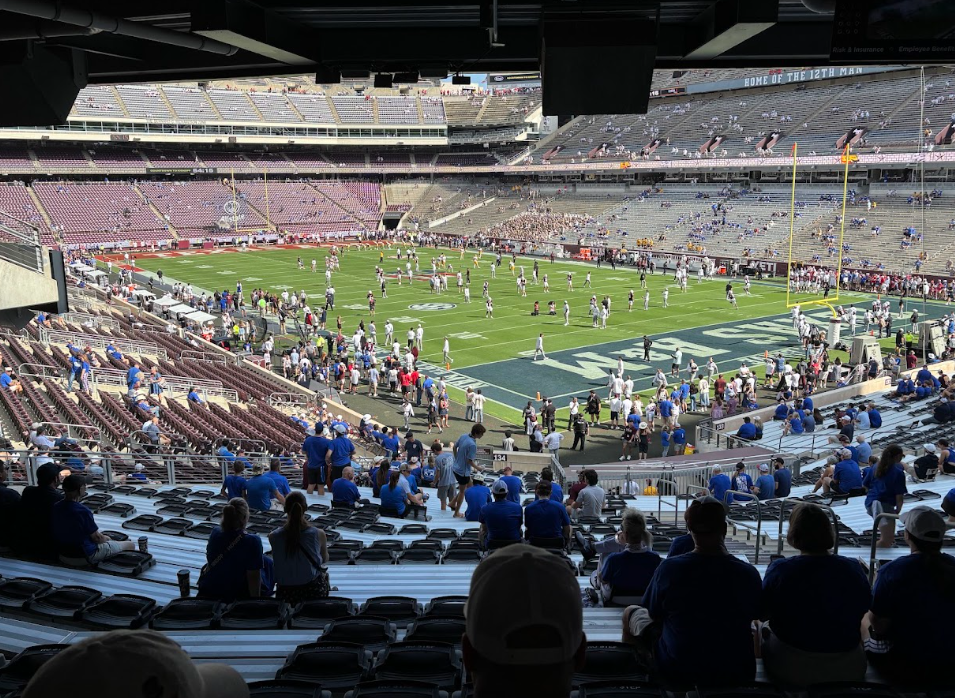
Fans take their seats as players warm up at Kyle Field in College Station, Texas, before Arizona State’s game against Texas A&M on Sept. 12, 2026. Courtesy of the Edling family.
Arizona State had the ball at Texas A&M’s 34-yard line and a chance to pull itself back into the game.
One snap later, the opportunity was gone.
With 8:52 remaining Saturday at Kyle Field, the Sun Devils took over on downs after Aggies punter Tyler White fumbled and recovered his own ball short of the first-down marker. Trailing 31–20, ASU needed a touchdown. Instead, Cutter Boley threw under pressure from T.J. Searcy, and defensive end Marco Jones intercepted the pass and returned it 55 yards for a score.
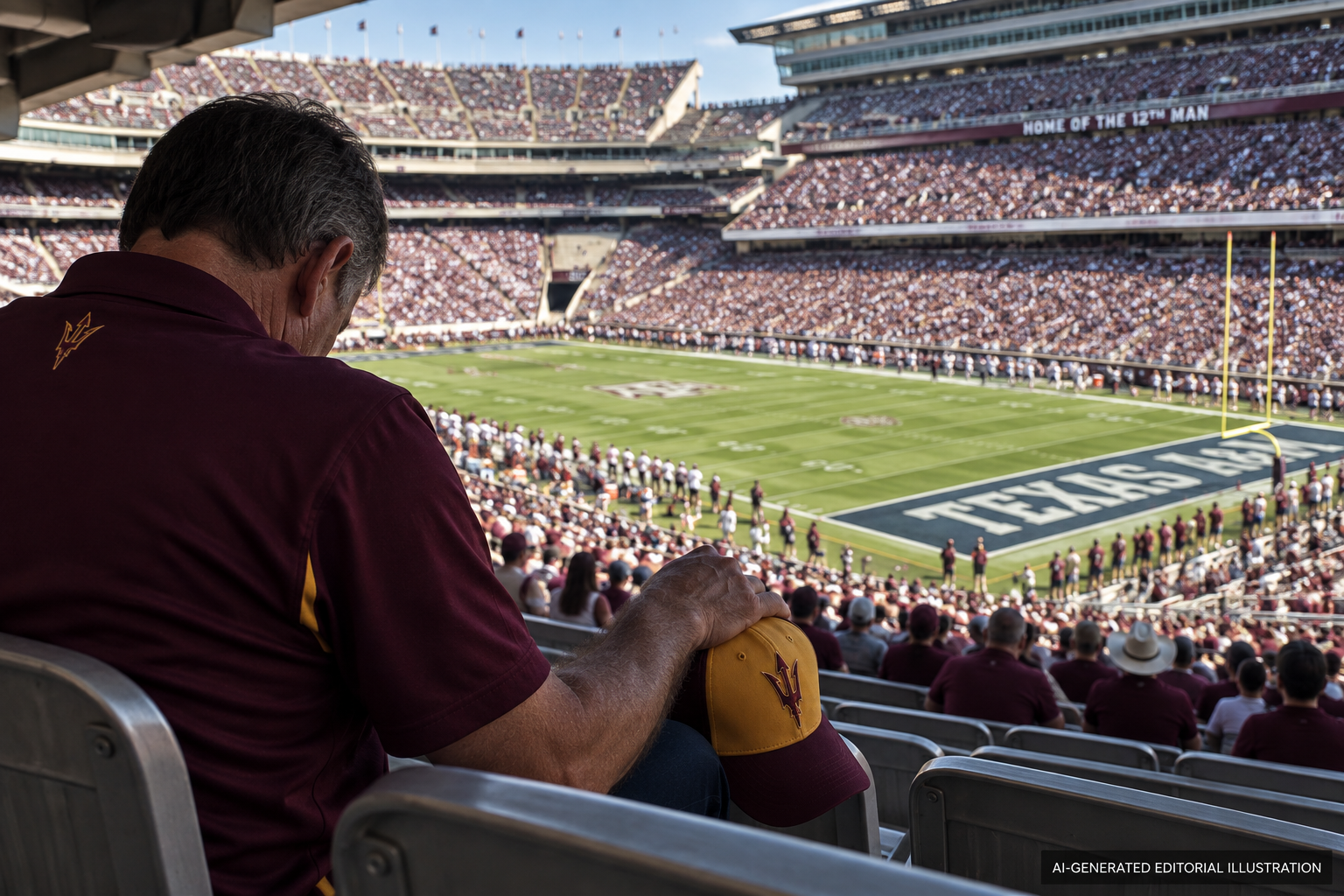
An Arizona State fan in the Kyle Field stands during the Sun Devils’ 48–20 loss to Texas A&M on Sept. 12, 2026. AI-generated editorial illustration.
That reversal defined No. 10 Texas A&M’s 48–20 victory over Arizona State on Sept. 12. The Sun Devils entered the fourth quarter four points behind. They left College Station at 1–1 after surrendering 24 unanswered points in the final period. Texas A&M improved to 2–0.
The margin demands an explanation beyond the familiar complaint that a team failed to finish. Arizona State moved the ball, produced an outstanding receiving performance and repeatedly stopped the Aggies. It also made mistakes that required its opponent to travel very little distance—or no offensive distance at all—to score.
The sequence after Jones’s touchdown made recovery increasingly unlikely. Kyson Brown lost a fumble on ASU’s next offensive snap. Texas A&M turned the short field into a field goal. Julio Humphrey then intercepted Boley on the following Sun Devils possession and returned it 45 yards for another touchdown. The Aggies’ defense had scored twice in the fourth quarter.
Three consecutive Arizona State possessions ended in turnovers. Those possessions produced 17 points for Texas A&M: 14 from the two interception returns and their extra points, and three following Brown’s fumble. ASU’s chance to answer an 11-point deficit became a 28-point defeat.
“Those plays count, and they count for more than the other plays,” coach Kenny Dillingham said after the game.
The afternoon supplied the arithmetic behind his point.
Arizona State outgained Texas A&M 369–255. But the Aggies forced four turnovers while committing one, and their advantage extended to special teams. The Sun Devils repeatedly gave an inconsistent A&M offense favorable starting positions.
Twenty of Texas A&M’s points came on offensive possessions that began inside ASU territory. The short fields reduced how much an inconsistent offense needed to accomplish before putting points on the board.
The field-position problems were present long before the game broke open. Cory Butler Jr.’s muffed punt gave Texas A&M the ball at the ASU 8 in the first quarter. The failed fake punt set up a field goal before halftime. Terry Bussey’s return late in the third quarter started the drive that ended with Marcel Reed’s 33-yard touchdown pass to Mario Craver early in the fourth.
Texas A&M capitalized on those chances. The Sun Devils created too few obstacles between a mistake and its consequences.
Responsibility also extended beyond the quarterback. Dillingham took the blame for the play-action shot he called after the failed Aggies punt, acknowledging that he had become too aggressive. He attributed another interception to miscommunication that left a defender unblocked. Boley, meanwhile, accepted responsibility for forcing throws.
Those explanations identify work for the coaching staff as well as the players. A sudden change of possession can invite an immediate shot at the end zone. It still requires a call the offense can execute, clear assignments and a quarterback willing to abandon the throw when it breaks down.
For much of the game, Boley and Reed Harris gave ASU reason to believe it could win. Boley completed 21 of 34 passes for 254 yards, two touchdowns and two interceptions. Harris caught nine passes for 189 yards and both touchdowns, including a 58-yard catch and run that brought the Sun Devils within 24–20 in the third quarter.
Harris accounted for nearly three-quarters of Arizona State’s passing yards. His ability to produce big gains kept the offense dangerous, but the concentration of production presents a question for the weeks ahead: how consistently can ASU create those opportunities elsewhere when an opponent makes Harris its priority?
One game cannot settle that question. It can establish what deserves attention.
The defense deserves an assessment of its own. ASU held Texas A&M to 255 total yards and three conversions in 12 third-down attempts. Lyrik Rawls intercepted Reed on the first play of the second half, creating a possession that ended in a Sun Devils field goal. Those were meaningful contributions in a game that remained within reach through three quarters. They deserve consideration when assessing how the Sun Devils played and what needs to change.
There were costly defensive mistakes, too. A third-quarter holding penalty erased an apparent fourth-down stop and extended an Aggies touchdown drive. The defense kept ASU competitive; it did not emerge without responsibility for the result.
For the Sun Devils, the correction list begins with punt execution, protection and communication after sudden changes of possession. The staff must also examine when aggression helps an offense and when it asks too much of a unit already trying to recover from a mistake.
Conference play arrives quickly. Arizona State faces Kansas at Wembley Stadium in London on Saturday, Sept. 19. The Union Jack Classic kicks off at 9 a.m. Arizona time on FS1.
“This isn’t a vacation. We have to get better,” Harris said afterward.
College Station made the assignment clear. The Sun Devils can create opportunities against a ranked opponent. Their next step is to stop turning those opportunities into points for the other team.
Game at a glance
| Team | 1st | 2nd | 3rd | 4th | Final |
|---|---|---|---|---|---|
| Arizona State | 7 | 3 | 10 | 0 | 20 |
| Texas A&M | 7 | 10 | 7 | 24 | 48 |
Arizona State finished with 369 yards to Texas A&M’s 255, but committed four turnovers to the Aggies’ one.
Sun Devils on the Road

Ed Edling, father of Meridian founder Andrew Edling, enjoys barbecue in College Station after the Sun Devils’ game against Texas A&M on Sept. 12, 2026. Courtesy of the Edling family.
 The Maricopa Meridian
Leave a comment