FOOD & DRINK
At a Fatburger on Tatum Boulevard, a pound and a half of beef, a stopwatch and one very bad idea became a permanent piece of Cave Creek history.
By Andrew Edling
Maricopa Meridian · Cave Creek, Arizona · September 13, 2026
CAVE CREEK, Ariz. — There are hamburgers, and then there are engineering problems disguised as lunch.
The XXXL at Fatburger belongs to the second category.
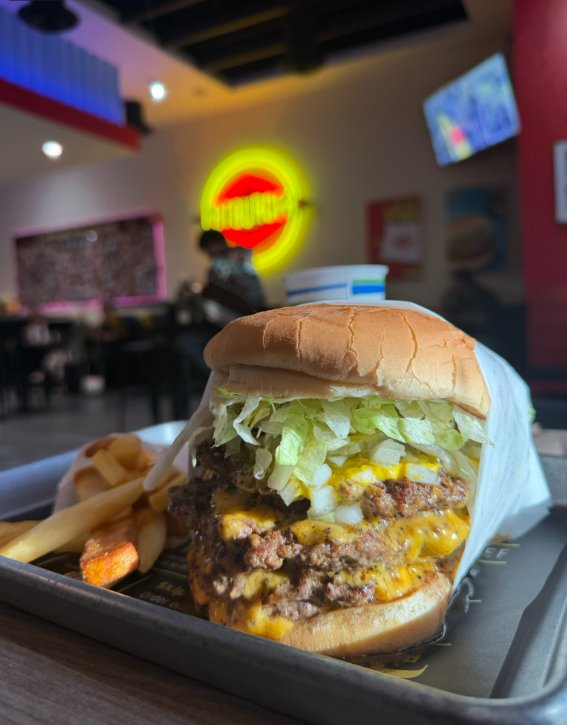
Three half-pound patties. Cheese. Bun. Lettuce, tomato, onions, pickles, condiments—all the usual democratic furniture of the American hamburger, except now buried beneath enough beef to make the whole enterprise seem vaguely confrontational.
The restaurant gave me twelve minutes to finish it.
I needed four minutes and forty-seven seconds.
My photograph is still on the wall.
This is not among mankind’s great achievements.
No bridge was built. No disease cured. No child rescued from a burning building.
I ate an unreasonable hamburger very quickly.
And yet I remain embarrassingly pleased about it.
Fatburger makes sense once you understand where it came from. Lovie Yancey opened the original stand in Los Angeles in 1947, and the basic proposition was never especially complicated: give people a serious hamburger and don’t be stingy about it.
That sounds obvious now.
It wasn’t always.
And perhaps more importantly, there is dignity in a business that understands its purpose. Fatburger is not trying to convince you that a hamburger is a spiritual journey through locally sourced beef terroir. Nobody appears tableside with tweezers. Nobody explains that the ketchup has been “reimagined.”
It is a hamburger joint.
The beef arrives.
You eat it.
Everybody goes home.
The XXXL simply takes this admirably straightforward philosophy and drives it through the guardrail.
A pound and a half of beef is not an improvement on a hamburger in the conventional sense.
At some point, scale becomes its own flavor.
The third patty is not there because the chef has discovered some previously unexplored balance between meat and bread.
The third patty is there because America looked at two patties and asked the question America has been asking since somebody put an engine in a wagon:
Can we make this bigger?
Apparently, yes.
The challenge turns the whole thing into theater.
There is a clock.
There is a wall.
There are photographs of people who came before you, evidence of previous encounters between appetite and questionable judgment.
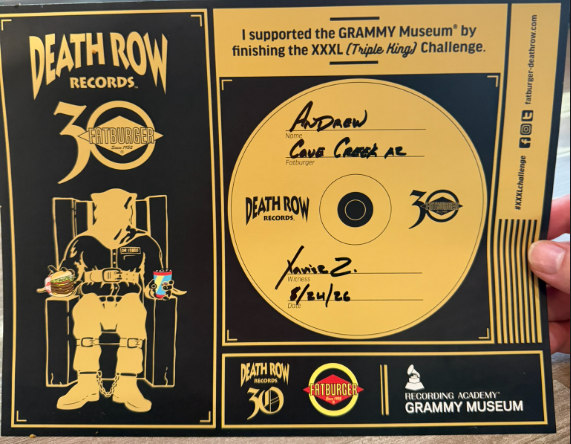
The rules are wonderfully free of ambiguity.
Eat this enormous bastard.
Do it before the clock expires.
Get your picture on the wall.
Civilization has produced more sophisticated rituals.
Few are easier to understand.
Once the clock starts, however, the XXXL ceases to be a hamburger.
This is important.
A hamburger is something you enjoy.
A food challenge is work.
Civilization has produced more sophisticated rituals. Few are easier to understand.
The bun is no longer bread. It is material.
The beef is inventory.
Chewing becomes production.
The clock does not care whether you are experiencing pleasant notes of pickle acidity.
You stop contemplating food and begin moving it.
Two hundred eighty-seven seconds later, the plate was empty.
Seven minutes and thirteen seconds remained.
I had badly overprepared for the deadline.
Now, years later, I am not going to tell you that I vividly recall the exact char on the patties or some particular interaction between mustard and onion.
I don’t.
Anyone claiming exquisite sensory memory from a 4-minute-and-47-second speed run through one and a half pounds of beef is probably selling you something.
I remember the size.
I remember the clock.
I remember finishing.
And I remember getting my photograph on that wall.
That’s enough.
The photograph is actually why the place interests me now.
Restaurant people spend fortunes trying to manufacture “community.”
They hire consultants.
They build brand identities.
They commission murals with inspirational slogans painted in tasteful typefaces.
Fatburger put up photographs of lunatics who ate a giant hamburger.
Much more effective.
A wall like that transforms a franchise.
Suddenly this isn’t merely one unit in an international restaurant company. It’s the Fatburger where somebody’s brother tried the XXXL and failed. Where your coworker swears he could beat the record. Where some idiot from Long Beach came in one day and annihilated the thing in 4:47.
That idiot was me.
There is some Los Angeles DNA in all this.
Fatburger was born there. I’m from Long Beach. The company later collaborated with Death Row Records—another unmistakably Southern California institution—around the XXXL. That’s a nice wrinkle in the story.
But it isn’t the story.
The story is sitting on Tatum Boulevard.
Arizona sun outside.
Air conditioning inside.
Parking lot shimmering.
A plastic tray on the table.
Three patties stacked high enough to require consideration.
The Cave Creek location doesn’t need to masquerade as some great Arizona culinary landmark. That’s not what it is.
It is a burger joint in the North Valley.
And sometimes that is sufficient.
A restaurant earns affection in strange ways.
The finest meal of your life may disappear into memory.
Meanwhile, some objectively stupid afternoon involving a stopwatch and a grotesquely oversized hamburger remains perfectly intact.
That tells us something uncomfortable about memory.
Possibly something about men.
Certainly something about hamburgers.
So should you order the XXXL?
Probably not.
If you’re hungry, get a normal burger.
If you’re very hungry, get a bigger burger.
If you’ve reached the point where one and a half pounds of beef sounds like a sensible nutritional decision, I am not qualified to help you.
But if somebody puts twelve minutes on a clock?
Well.
Now we’re discussing something else.
The Fatburger on Tatum gave me an enormous hamburger, a challenge, a story and a small patch of immortality on a restaurant wall.
The burger disappeared in 4:47.
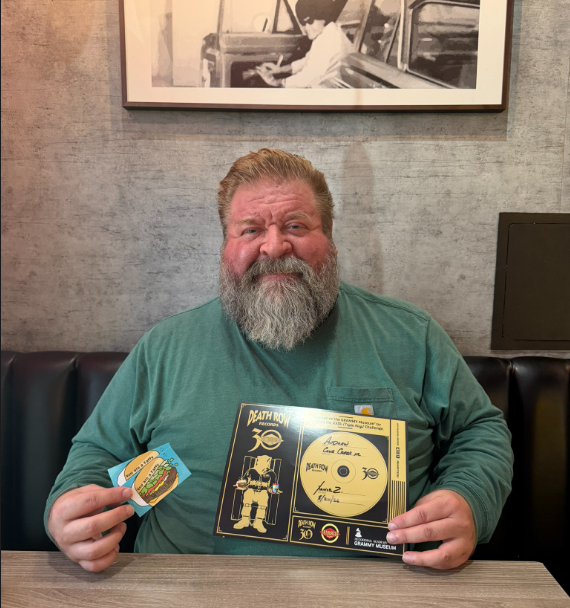
The photograph didn’t.
— 30 —
For a meal I consumed almost too quickly to taste, it has lasted a remarkably long time.
Worth leaving the house for?
Obviously.
I’m still talking about the damn thing.
 The Maricopa Meridian
Leave a comment