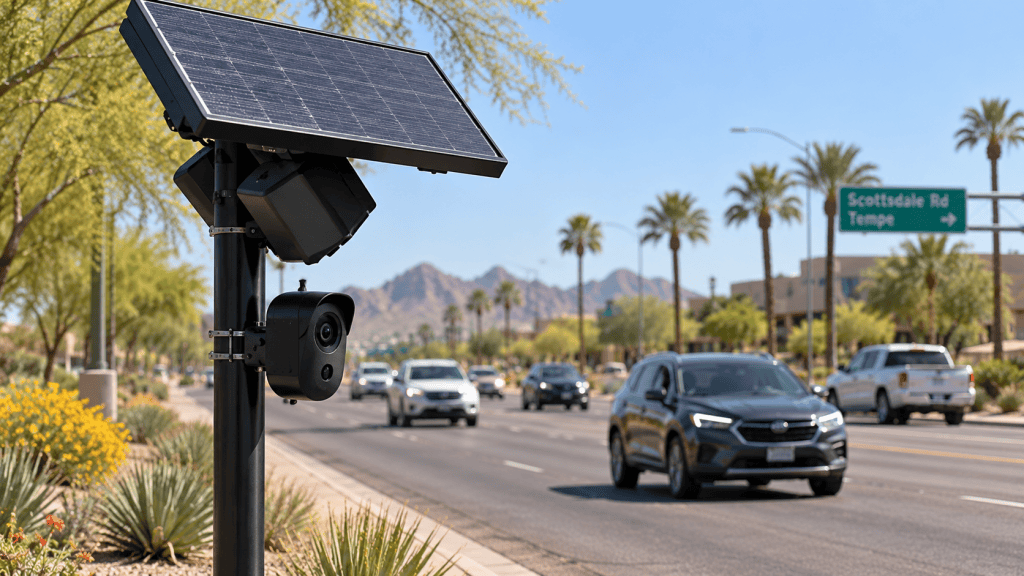
Neighboring cities are taking different paths on license-plate surveillance. The debate turns on investigative value, personal misuse and whether the public can measure the trade-off.
News analysis • Information checked September 9, 2026
Tempe switched off its Flock license-plate camera system on Aug. 26. Across the city line, Scottsdale continued operating a network reported to include 85 readers while officials considered stronger safeguards.

The decisions expose a disagreement about how much surveillance a city should accept in the name of public safety. Both cities have described the technology as useful. Both have said their reviews found no internal misuse. They have nevertheless reached different judgments about the risks.
Tempe’s police announcement said its cameras had stopped collecting plate data, that Flock would remove its equipment and that the city would not seek a replacement. The city had already announced an end to Flock data sharing on Aug. 11. Its shutdown concerns a particular license-plate system; it should not be read as an end to every kind of police camera.
Scottsdale, meanwhile, has proposed an independent audit and other changes. According to recent reporting by Axios and ABC15, officials are examining oversight, retention and the possibility of using another vendor.
The question for Valley residents is whether the benefits of a searchable vehicle database justify its reach—and whether cities can demonstrate that the people using it stay within the rules.
What the cameras record
Flock’s license-plate readers capture plates and vehicle characteristics that can become investigative leads. The company says officers can search full or partial plates, use vehicle descriptions and receive alerts when a plate matches a watchlist. Authorized sharing can connect sightings across jurisdictions.
These capabilities can help investigators narrow a search when they know a vehicle’s plate or only part of its description. Flock markets the system for recovering stolen vehicles, locating missing people and investigating violent and property crimes.
The company says its LPR product does not include facial recognition. It also sells other technologies. A department’s use of plate readers does not establish that it has purchased or enabled every feature in Flock’s wider product line.
A vehicle match also has limits. It cannot establish who was driving, why the vehicle was there or whether a crime occurred. An investigator still has to connect the sighting to reliable evidence.
Flock’s own license-plate-reader policy acknowledges that automated plate translations can be incomplete or inaccurate. It directs users to confirm the translation before acting on an alert or search. The company’s acknowledgment does not supply a local error rate, but it makes verification an essential part of evaluating any department’s use.
The value police see
The strongest argument for the system is practical: a timely vehicle sighting can give police a place to look. When a person is missing or a stolen vehicle is moving between cities, narrowing that search can matter.
Tempe’s decision acknowledged that value. Business Insider’s Aug. 26 account reported that Mayor Corey Woods credited the cameras with helping officers while explaining that the potential for misuse and the need to preserve public trust supported ending the program. The same report said Tempe operated 33 cameras and that monthly audits had found no improper searches.
That leaves an important distinction between usefulness and overall effectiveness. A system can assist in an individual investigation without demonstrating that its deployment reduced crime across a city.
To assess the broader return, residents need comparable figures: how often officers searched, how many alerts they verified, which searches contributed to recoveries or resolved cases, and what the program cost. The reporting reviewed for this article does not establish those measures consistently across the two cities.
Counting an arrest as a result also requires care. Arrests are not convictions, and a camera may be one of several sources that contributed to an investigation. Clear definitions would help the public understand what a claimed success actually represents.
A meaningful comparison would also examine other changes in policing, staffing and crime trends. Otherwise, a decline that coincides with camera installation can be mistaken for proof that the cameras caused it.
When access becomes personal
The concern about improper searches has a concrete Arizona example. In an Aug. 12 report, KTAR relayed Apache Junction police statements that an officer resigned after an investigation into using the Flock system to locate his wife during a personal dispute. The department said the use violated its policies.
The report also described Chief Michael Pooley’s continued support for the technology, coupled with a call for safeguards that would sustain public confidence.
That episode does not establish misconduct in Tempe or Scottsdale. It does show why a policy against personal searches and a record of searches performed are only part of the protection residents need.
An audit can reveal abuse after a search has happened. Its strength depends on what reviewers examine. Recording a case number is different from checking that the case exists, that the search relates to it and that the person conducting it has a legitimate role.
Likewise, a statement that an audit found no misuse is meaningful within the limits of that audit. The public needs to know the period covered, how searches were selected for review and which forms of misuse the process could detect.
How long the record survives
Retention is another area where a general description of Flock can obscure local decisions.
Flock’s current policy describes automatic deletion on a rolling seven-day basis by default, with different periods permitted when required by a customer’s law or policy. That does not mean every existing customer deletes records after one week.
ABC15 reported in early September that Scottsdale kept camera information for about six months and that city leaders planned to examine whether that period could be shortened without impairing investigations. This article has not independently verified Scottsdale’s live retention setting.
Longer retention provides more history for investigators to search. It also expands the period over which someone with access could examine repeated appearances of a vehicle. Those appearances can suggest patterns, although they do not prove a particular person’s movements.
Deletion from the ordinary search system presents a further question: what happens to records preserved or exported for a case? A public retention policy should explain the treatment of those records as well as the routine database.
Sharing deserves the same precision. A list of agencies permitted to search local data is different from a record of agencies that actually did so. To assess oversight, residents need to understand both the access rules and how officials check their use.
What stronger oversight would show
Scottsdale’s proposed changes include an independent city audit, a public transparency website and a possible ordinance addressing intentional misuse, ABC15 reported. Officials also plan to evaluate alternative vendors. These are proposals and review commitments, rather than evidence that every measure has already taken effect.
Axios reported that Scottsdale described existing protections including individual credentials, documented law-enforcement purposes and quarterly audits. The city said those audits had found no misuse.
An independent review could make those assurances easier to evaluate. It could describe the number and types of searches examined, whether investigators checked underlying case files, and how exceptions were handled. It could also distinguish searches by local personnel from access by outside agencies.
Flock says customers control their data and sharing and that searches are logged and reviewable. Those controls provide a basis for oversight; their presence does not settle whether a particular department uses them effectively.
Changing vendors would require similar scrutiny. The relevant comparison is what information a replacement collects, who can search it, how long it remains available and how misuse is detected.
A decision bigger than one contract
On Aug. 27, Arizona Attorney General Kris Mayes announced a statewide review of automated license-plate readers, including privacy effects and potential Fourth Amendment concerns. Her office said it would report its findings to the Legislature and governor. The announcement began an examination; it was not a ruling that the systems are unconstitutional.
The review brings a statewide dimension to decisions currently being made city by city. A driver crossing municipal boundaries may encounter different rules for collection, retention and access without any obvious indication that those rules have changed.
For now, Tempe has ended its program. Scottsdale has kept its system while considering additional oversight. The record reviewed here supports both the existence of investigative uses and a documented example of personal misuse. It does not establish a complete local accounting of benefits, errors and costs.
That accounting is where the debate can move beyond assurances. Residents should be able to see what a system costs, what it accomplishes and what happens when someone uses it improperly. A camera count tells them how large a network is. It does not tell them whether the bargain is a good one.


Leave a Reply